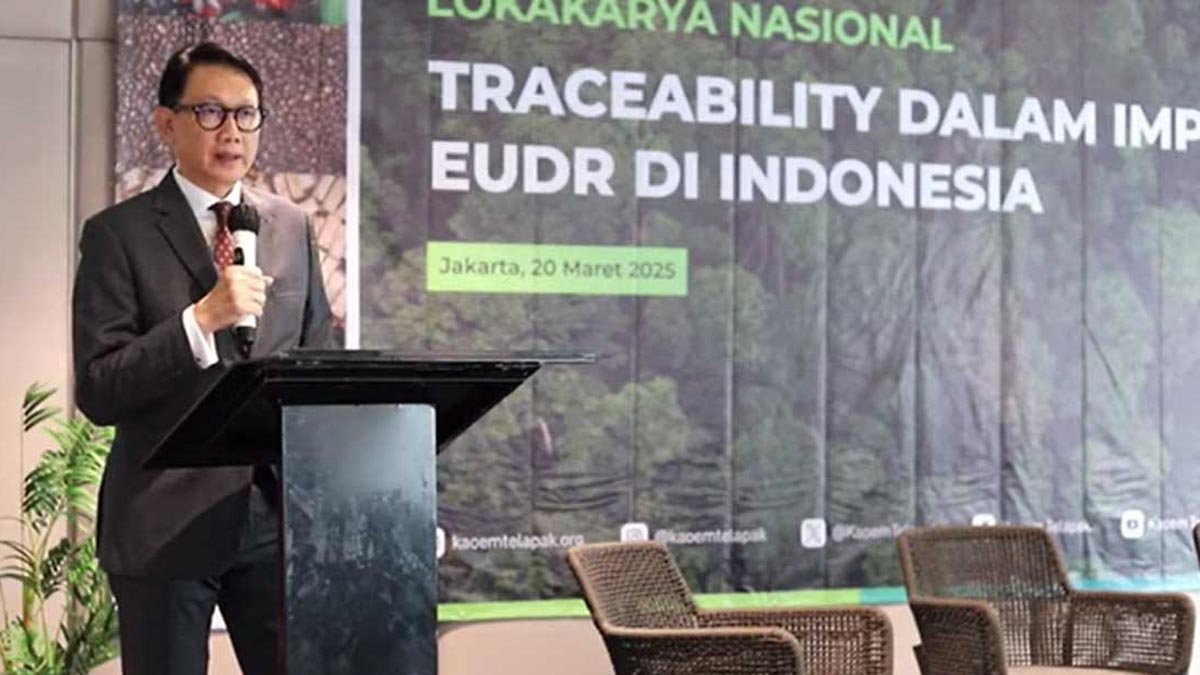
PALMOILMAGAZINE, JAKARTA – Deputy Minister of Foreign Affairs Arif Havas Oegroseno highlighted the challenges faced by small coffee and palm oil farmers in complying with the European Union Deforestation Regulation (EUDR). Speaking at an event in Jakarta, he emphasized that the regulation requires small farmers, cooperatives, and exporters to fully understand strict requirements before their products can enter the European market.
“Many coffee farmers export directly, while small-scale palm oil farmers typically sell their harvests to large industries that handle processing or exports,” Havas explained. “As a result, coffee and cocoa farmer cooperatives that export are classified as operators and must comply with Articles 2(15) and 2(16) of the EUDR regulation.”
According to Havas, the regulation imposes obligations on operators to understand various trade rules, including Article 4 on operator responsibilities and Article 8 on export technical requirements. “Article 9 regulates auction requirements, while Article 10(2) and Article 11 require cooperatives to be aware of United Nations Security Council sanctions,” he added, as reported by Palmoilmagazine.com from Kaoem Telapak’s YouTube broadcast on Saturday, March 22, 2025.
Also Read: Building Energy Independence with More Sustainable Palm Oil
Geotagging: A Small Part of a Larger Compliance Puzzle
One of the key challenges in complying with EUDR is geotagging, which is often seen as the primary requirement. However, Havas stressed that geotagging is only a small part of a much broader set of conditions.
“The discussions in Rotterdam recently revealed that even European industries themselves are still debating the implementation of this regulation,” he noted.
Havas also raised concerns about transparency within EU regulations. He pointed out that while Indonesia’s Timber Legality Verification System (SVLK) and Forest Law Enforcement, Governance, and Trade (FLEGT) have been recognized, their implementation across European countries remains inconsistent.
“In Germany and France, these rules are well understood, but in Eastern European countries like Romania and Bulgaria, they are either unknown or disregarded,” he said.
Double Standards in EUDR Implementation?
Additionally, Havas questioned whether Indonesian farmers are being held to higher standards compared to their European counterparts.
“Are European timber farmers also required to provide geotagging? Are they ready to comply?” he asked.
This discussion served as a crucial moment for Indonesian stakeholders to deepen their understanding of EUDR and develop strategies to address its challenges. Given the complexity of the regulation, strong coordination between the government, industry, and farmers is essential to ensure that Indonesia’s agricultural exports remain competitive in the global market. (P2)